Introduction
If you’ve ever posted a Reel you were genuinely proud of, only to watch it sink without a trace, you already know that great content alone isn’t enough. Timing plays a real role in how many people see your video before the algorithm decides whether to push it further. Post when your audience is scrolling, and you give your content the best possible head start. Post into a dead zone, and even brilliant content can struggle to find its footing.
This guide breaks down what the latest 2026 data says about optimal posting windows on TikTok and Instagram, why timing matters in the first place, and how to figure out the actual best time for your specific audience — because the honest answer is that general benchmarks are only a starting point.
Why Posting Time Actually Matters
Both TikTok and Instagram use engagement velocity — how quickly a video earns views, likes, comments, and shares after it’s published — as an early signal of quality. A Reel that racks up strong engagement in its first hour is more likely to get pushed onto the For You Page or the Explore tab, where it can snowball into much bigger reach. A Reel that gets posted into silence, with no one around to watch it, often never builds that early momentum, even if the content itself is excellent.
In short: timing doesn’t guarantee virality, but it does influence whether your content gets a fair shot at the algorithm’s attention.
Best Time to Post on TikTok
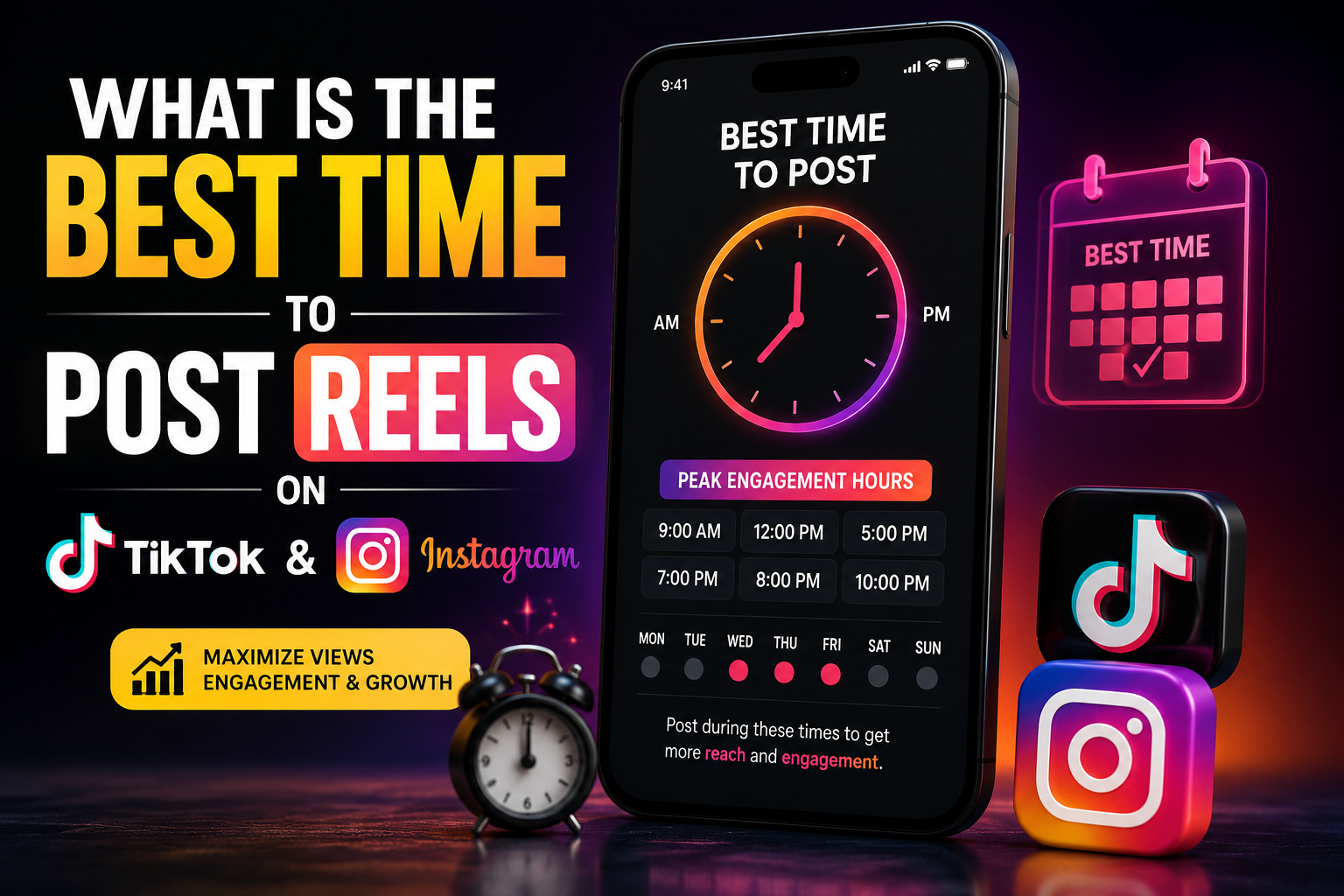
According to a 2026 study from Metricool covering more than 2 million posts across over 92,000 accounts, the best time to post on TikTok is between 6:00 PM and 8:00 PM.
Other large-scale studies point to a similar pattern. Data aggregated from Buffer, Sprout Social, Hootsuite, Later, and several other analytics platforms found that Tuesday through Thursday evenings, roughly 6 to 9 PM in your audience’s local time, is the most reliable posting window on TikTok. Multiple independent creator reports back this up anecdotally — one creator quoted in a 2026 roundup said their average TikTok views jumped from 5,000 to 25,000 after switching from posting at 2 PM to posting at 8 PM.
TikTok cheat sheet:
- Prime window: 6:00 PM – 9:00 PM (local audience time)
- Best days: Tuesday through Thursday
- Why it works: This window lines up with people winding down after work or school, when phone usage tends to spike
Best Time to Post Instagram Reels
Instagram’s patterns are a little more nuanced, largely because the platform serves such a broad, varied user base. Metricool’s 2026 Instagram study, which analyzed activity across professional accounts, found that the general sweet spot is 6:00 AM to 9:00 AM, with 8:00 PM standing out as the single highest-performing hour for views. The same study noted that 2:00 PM is also a strong performer, likely thanks to people scrolling during their lunch break.
Looking specifically at Reels rather than all Instagram content, a few other data sources add useful detail:
- A combined analysis of Buffer, Sprout Social, and other 2026 datasets found that weekday midday (11 AM–1 PM) and evenings (6–9 PM) lead engagement for Instagram Reels.
- Statista’s analysis of Reels performance found that 6 PM is the single most popular hour among creators for posting, and that despite this, Reels only get posted monthly by about 20.7% of creators — even though Reels carry a 1.23% engagement advantage over other formats on the platform. That’s a real gap between how well Reels perform and how consistently people actually use the format.
- A separate 2026 guide recommends weekday mid-mornings (9–11 AM) and lunch breaks (12–1 PM) as the best overall Instagram windows, with weekday evenings (7–9 PM) specifically favored for Reels.
Instagram Reels cheat sheet:
- Prime windows: 6:00–9:00 AM, 12:00–2:00 PM, and 6:00–9:00 PM
- Standout single hour: 8:00 PM
- Best days: Weekdays generally outperform weekends, though evenings hold up well across the whole week
The Midnight and Late-Night Wild Card
Here’s where things get counterintuitive. Several 2026 studies point to very late posting — around midnight — as a surprisingly strong performer for short-form video.
Metricool’s Short-Form Video Study specifically found that the best time to post Reels overall is midnight on Saturday, a slot late-night scrollers appear to love. A separate Statista analysis of over 1.6 million short-form videos backed this up, finding that Reels posted at midnight generated the highest average views of any time slot, averaging around 25,000 views per Reel.
The logic behind this isn’t mysterious. As one industry guide put it, posting when competition is low means less content from other creators crowding the algorithm, giving a Reel published around 1 AM several quiet hours to build engagement from late-night viewers and international audiences before local followers wake up for their morning scroll.
This won’t be the right strategy for every account — a B2B brand’s audience isn’t awake and scrolling at midnight the way a Gen Z entertainment audience might be — but it’s worth testing if your niche skews toward younger or night-owl audiences.
Why “Prime Time” (7–11 PM) Keeps Showing Up
A recurring theme across nearly every study is that the traditional evening hours dominate, much like they did for television. One analysis explained it well: the window between 7 PM and 11 PM functions as a kind of “prime time” for social media, mirroring the peak hours of broadcast TV, and captures users as they unwind after work or school and settle in after dinner.
This matters because when more people are actively scrolling, there’s more potential for eyes on your content the moment it goes live, and that immediate burst of engagement signals to the algorithm that the content is worth pushing to a wider audience.
Don’t Ignore Morning and Lunch Windows
Evenings aren’t the only game in town. A number of studies highlight the mornings and lunch breaks as genuinely strong secondary windows:
- Posting during the early weekday morning window of 8–10 AM taps into a universal moment of digital check-in — people commuting, drinking their morning coffee, or taking a break before diving into work, which sets content up for a full day of visibility.
- Lunchtime engagement — likes, shares, and comments accumulating quickly during the midday break — can signal to the algorithm that a Reel is a must-see, especially since both Instagram and TikTok favor content that gains views and interaction quickly, and that early velocity can help propel a Reel onto the For You and Explore pages.
Best Days of the Week
Day-of-week patterns are fairly consistent across platforms:
- Tuesday–Thursday is the strongest stretch for TikTok, according to combined 2026 study data.
- Monday to Wednesday tends to work well on Instagram as people settle into their weekly routine, with lunch hours (11 AM–1 PM) or early evening (6–9 PM) as the best slots during this stretch.
- Thursday and Friday often see rising engagement as the week builds toward the weekend, particularly during lunchtime and late afternoon.
- Weekends are underrated. Contrary to the assumption that people log off on Saturday and Sunday, brunch hours (10 AM–12 PM) or early evening can be opportune windows for Reels on both days, and Saturday midnight, as noted earlier, is one of the single best-performing slots in some studies.
Quick Reference Table
| Platform | Prime Window | Best Days | Standout Slot |
|---|---|---|---|
| TikTok | 6–9 PM | Tue–Thu | 6–8 PM |
| Instagram Reels | 6–9 AM, 12–2 PM, 6–9 PM | Weekdays (Mon–Fri) | 8 PM |
| Both (wild card) | Late night | Saturday | Midnight |
Why Generic Advice Only Gets You So Far
Every study cited here is observational, drawn from broad averages across millions of accounts. Your audience might not behave like the average. A gaming channel’s peak hours will look nothing like a B2B consultancy’s, and a creator with a large international following needs a completely different strategy than one whose audience is concentrated in a single city.
If a meaningful share of your followers live in a time zone several hours removed from your own, it may be worth testing content scheduled for their morning rather than yours. As one guide suggests, reviewing your own analytics to understand audience geography, then using a scheduling tool that supports multiple time zones, can help ensure content is fresh when your key international audience wakes up — and if you do this, it helps to open with a strong visual hook or question, since the first three seconds are what stop a morning scroller from swiping past.
How to Find Your Best Time (Not Just The Best Time)
The most reliable posting schedule is the one built from your own data, not someone else’s. Here’s a simple way to test it:
- Check your native analytics. Both TikTok and Instagram show you when your specific followers are most active, directly in their creator/business dashboards.
- Form a hypothesis. Pick 2–3 candidate time slots based on that data — for example, Tuesday at noon, Thursday at 6 PM, and Saturday at 11 AM.
- Run a real test. Create 4–6 Reels similar in topic, style, and format, and post one per slot over one to two weeks.
- Track first-24-hour performance. Record views, likes, comments, and shares within the first 24 hours for each Reel.
- Lock in the winner — then keep re-testing. After 2–4 weeks, the data should show which slots consistently outperform, and it’s worth locking those into your content calendar and re-testing every 3–4 months as your audience evolves.
How Often Should You Post?
Timing only helps if you’re posting consistently enough to give the algorithm data to work with. Three to five Reels per week is a solid baseline for most creators — enough volume to build momentum without burning out your creative process.
The Bottom Line
If you want one number to start with: 6–9 PM on weekdays is the closest thing to a universal sweet spot across both TikTok and Instagram Reels in 2026, with 8 PM repeatedly standing out as the single strongest hour. Morning (6–10 AM) and lunchtime (12–2 PM) windows are strong secondary options, and if your audience skews younger or more nocturnal, don’t discount posting around midnight, especially on Saturdays.
But treat all of this as a hypothesis, not a rule. The creators who consistently win aren’t the ones who memorized a chart — they’re the ones who test, measure, and adjust based on how their specific audience actually behaves.